Your working groups quarterly update (fall '25)
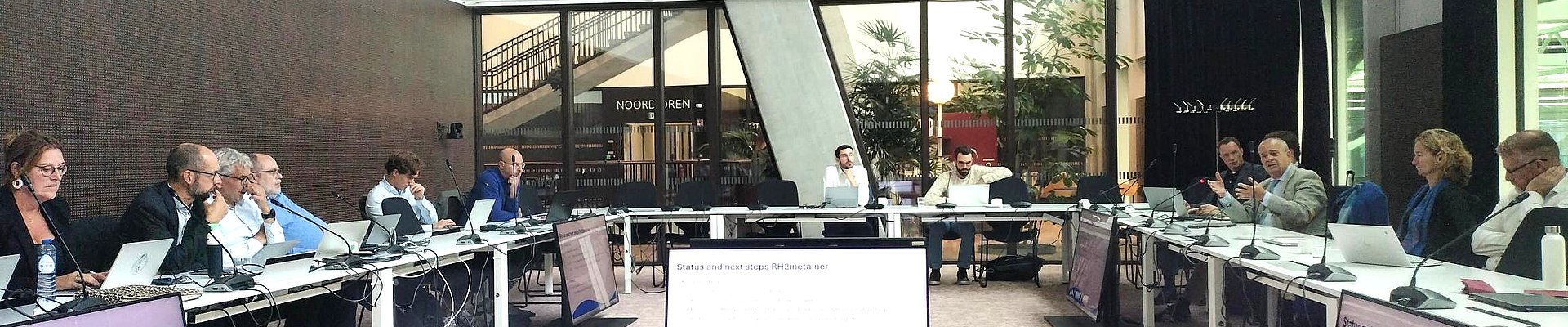
As we move into the fall season, we are pleased to share the latest developments from the RH2INE working groups - presented at the Vlaamse Waterweg in Brussels - highlighting the progress and key activities across the different themes.
Standardization
The working group on standardization will contact Loyds Register to discuss the reference energy compartment and tanktainer. So far, the discussions have been positive. The group agreed that a dependency assessment should be conducted instead of a full risk assessment.
The sizes for the hydrogen supply and vent lines in the multiconnector have been agreed upon.
As the next topic, the focus will shift to the filling side, which will be discussed in collaboration with EIGA (The European Industrial Gases Association).
Market development
The new Condor-ZE Foundation has recently begun its activities, with RH2INE serving as a member of the advisory board. Condor-ZE will now initiate an in-depth analysis of three sub-markets: consumer brands, sand and gravel, and sustainable fuels. For each of these segments, the main drivers, key partners, and relevant tools have been identified and described.
The next step will involve starting discussions with stakeholders from each of these market segments.
Tanktainer pool company
The new entity, referred to as ‘NewCo’, will be established as a Special Purpose Vehicle (SPV). Its primary objective is to lower market entry barriers for hydrogen-powered inland navigation. In doing so, it seeks to minimise the total cost across the value chain by enabling a higher turnaround of tanktainers. This setup is intended to facilitate the broader development of hydrogen applications in inland shipping.
NewCo will be operational for a period of ten years. An exit strategy is foreseen after this ten-year period, or earlier if the hydrogen market reaches maturity sooner. The company will offer long-term operational leasing, using a ticket system that provides users with the right to guaranteed availability of tanktainers. However, these tickets will not be assigned to specific tanktainers. All tanktainers deployed under NewCo must conform to a standardized design, as defined by the Standardisation Working Group.
A significant part of NewCo’s operations will be outsourced based on criteria such as cost, quality, and performance. This includes logistics, operational planning, and maintenance. While physical maintenance tasks will be outsourced, NewCo will remain responsible for preventive maintenance. A structured preventive maintenance program will be developed and implemented under NewCo’s supervision.
In addition, NewCo will establish a formal crisis management structure. This will include clearly defined responsibilities for each container, as well as predefined emergency roles and procedures. These measures are designed to ensure safety and a swift response in the event of incidents, whether they occur on land or at sea.
Importantly, hydrogen trading does not fall within the scope of NewCo. Shipping companies will be responsible for concluding hydrogen delivery contracts with hydrogen suppliers. These suppliers, in turn, will be responsible for filling the tanktainers and delivering them to the correct locations. The suppliers may subcontract these delivery tasks to transport companies as needed.
Form
NewCo will be set up as a private company and is expected to be profitable. However, a cap on profits—for example, 10%—will be implemented to keep the company attractive to investors and accessible to the inland barge community.
Size
The sizing of NewCo will follow a phased scaling strategy. This approach is designed to remain responsive to real-world customer needs while minimising upfront financial risks. The company will begin operations with a base of 20 tanktainers, consisting of 12 active tanktainers for two ships and 8 additional units held in reserve. As market demand grows, the company will scale accordingly. For each new vessel announced, an additional six tanktainers will be ordered.
Hand-over of tanktainers
Newco will work exclusively with certified suppliers. Certification will be carried out by a neutral certification organism, and ISO certification will serve as the standard. Shippers may only place orders with certified hydrogen suppliers.
A quality check of the tanktainers will be performed before, during, and after each filling. An ‘end of flange’ certificate will be provided for the respective filling, confirming compliance. The hydrogen delivered will meet the ‘fuel cell grade’ H₂ quality standard.
Repair of tanktainers
Any damage to the tanktainers will be inspected carefully. The receiving party is responsible for checking the condition of the tanktainer in accordance with the ITCO (International Tank Container Organisation) standard. The inspection will be carried out using ITCO’s ‘ACC’ (Acceptable Container Condition) Inspection Guidance to ensure compliance and safety.
Measurement systems:
Acceleration meters must be installed in each tanktainer. The maximum allowable acceleration level must be defined in the design phase in advance. Once this threshold is reached or exceeded, the tanktainer must be immediately rejected from use.
All meters must be calibrated regularly. This calibration will be included in Newco’s preventive maintenance schedule and must take place at least once per year.
Subsidies
An application was going to be submitted for the CEF call for the mobile tanktainer. As the initial financial partner withdrew two months before the application deadline, it was necessary to find a new financial partner within a very short timeframe. Unfortunately, this two-month window proved insufficient to complete the internal procedures required by the banks. Although four to five banks expressed interest in the proposal, they ultimately declined due to the tight timing.
It is therefore proposed to check the available budget for the last cut-off call and, if sufficient funds remain, to resubmit the Rh2intainer proposal before 4 March 2026. In addition, other potential funding mechanisms will be explored.
Policy
As business cases are developed, the impact of financial and policy measures will become clearer and better understood. The working group will define the boundary conditions for establishing a European stimulation fund for hydrogen-based inland shipping, taking into account existing subsidy opportunities and upcoming programs or mechanisms.
Existing instruments, such as contracts-for-difference and double-sided auctions, will also be further examined to assess their relevance and potential applicability.